
In August, a federal judge struck down a ban that froze immigrant visas for people from 75 countries, ruling that the government can’t sort would-be Americans by nationality. Tucson knows where that road leads.
Chinese immigrants arrived in the Southwest in the late 1800s, many working long, arduous hours to build the Southern Pacific Railroad. Yet the 1882 Chinese Exclusion Act banned future Chinese immigrant laborers and denied citizenship to those already in the U.S. Certain professions, such as merchants, were exempt, and a storefront became one of the surest ways to stay. By the 1940s, roughly 100 Chinese-owned grocery stores operated in downtown Tucson.
Understanding why a Chinese grocery store installation appears at the Tucson Museum of Art (TMA) means confronting generations of ingenuity and displacement. Tucson’s multicultural history defies a single narrative. And while over 40% of the city’s population today identifies as Hispanic or Latino, Tucson’s Chinese immigrant community has deep roots.
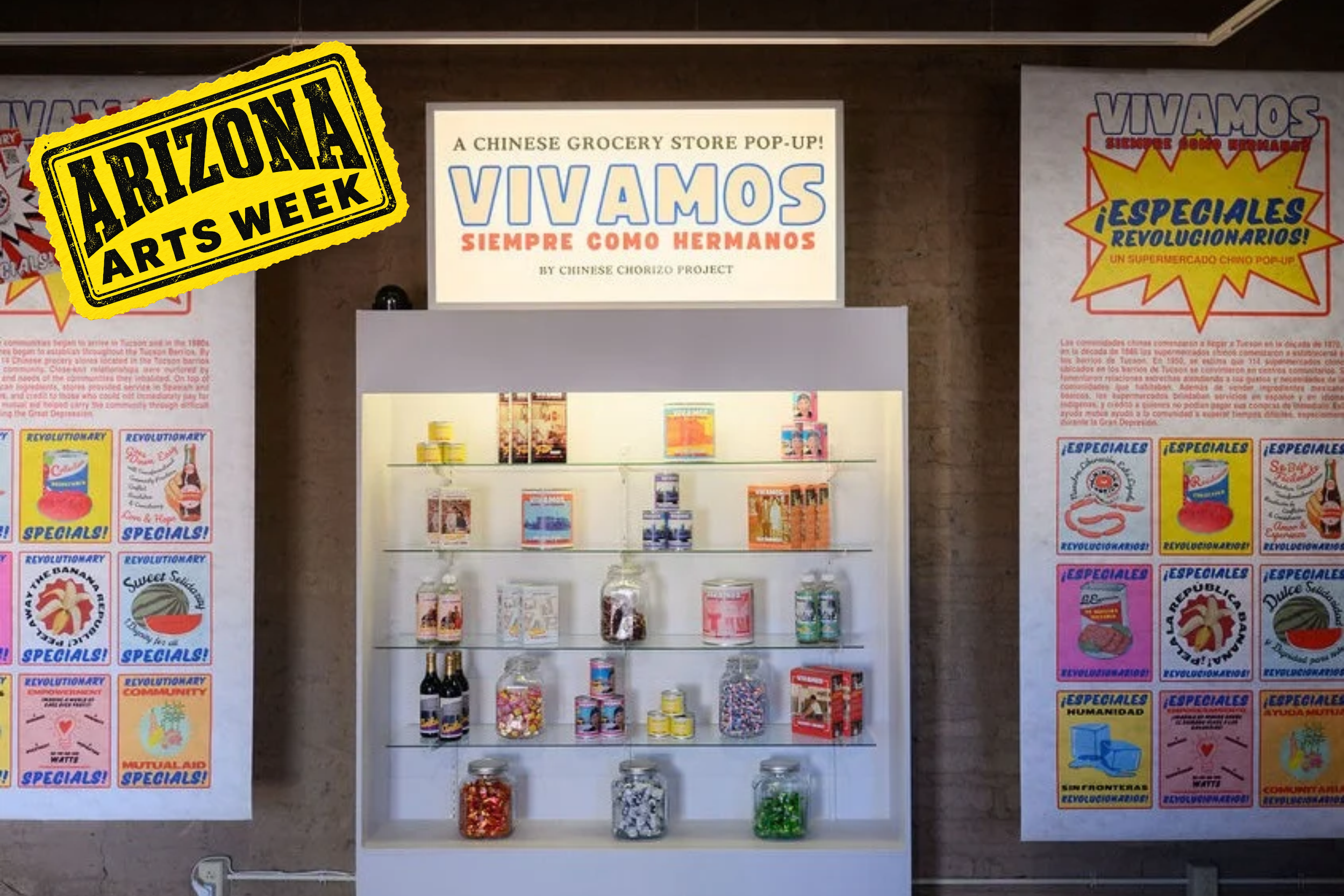
Vivamos Siempre Como Hermanos, on display at La Casa Cordova through December, occupies an original adobe house on TMA’s Historic Block and offers a peek inside this unique aspect of Tucson’s history. The title, borrowed from a painting by Stephany Zamarripa Castillo, translates to “let us always live as brothers.”

A recipe for solidarity
The exhibit, conceived by chef and multidisciplinary artist Feng-Feng Yeh, who also created The Chinese Chorizo Project, evokes solidarity among Tucson’s earliest residents. Long before credit cards became common, store owners extended credit, building trust across ethnic groups.
Chinese chorizo embodied the immigrant experience, using discarded cuts of meat, red wine, Mexican spices, and chiles, with each grocer developing a unique recipe.
“It is a recipe for solidarity,” Yeh writes on the project’s website. “Chinese chorizo is a metaphor for this rasquache immigrant experience: taking the little of what you have available and turning it into a feat of resilience.”
While Tucson City Council rejected creating a segregated Chinatown in 1893, the community was displaced to build a new City Hall, then forced to move again in the 1960s amid “urban renewal.” Even La Casa Cordova’s last resident, María Cordova, was forced out of the house in 1972.
The Chinese Chorizo Festival, now in its fifth year, returns through November 22, including collaborations with restaurants throughout Tucson and Phoenix, Borderlands Theater’s Barrio Stories, and the biannual Tucson Asian Night Market.
“Let us always live as brothers”—for generations, Tucson’s corner grocers kept that promise one open tab at a time.
Fast facts: Tucson Museum of Art and Historic Block
- Location: 140 N. Main Avenue, Tucson
- General hours: Wednesday–Sunday, 10 a.m.–5 p.m.
Vivamos Siempre Como Hermanos hours: Thursday–Sunday, 10 a.m.–5 p.m. - Also on display: Artes Gráficas de Oaxaca through January 10, 2027

It wants better content.